
Bullion vs. Portfolio Coins
What Smart Buyers Need to Know Before Investing
Understand the difference between gold bullion and portfolio coins, how pricing works, and why many investors use a combination of both for diversification. Learn more about our About Us page and explore our gold products and silver products.
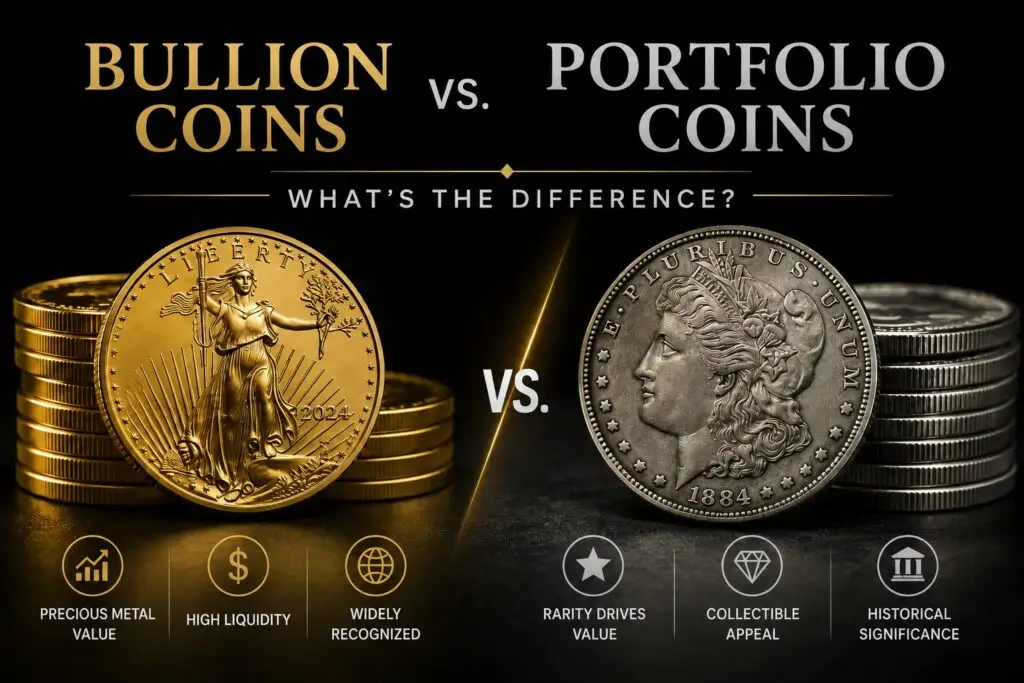
What's the Difference?
If you’re comparing bullion and portfolio coins, the most important thing to understand is this:
They are not competing products—they serve different roles.
- Bullion is primarily tied to the market price of gold or silver
- Portfolio coins are valued based on rarity, condition, mintages, grades and demand
Neither is inherently “better.” The right choice depends on what you’re trying to accomplish.
Bullion vs. Portfolio Coins at a Glance
Bullion(Gold & Silver Bar/Coins)
- Priced close to the current metal market (“spot price”)
- Premiums vary depending on supply and demand
- Highly liquid and widely recognized
- Value moves directly with market metal prices “spot price”
Portfolio Coins (Numismatics)
- Valued based on rarity, grade, and demand
- Finite supply—no additional coins can be created
- Not directly tied to daily spot price changes
- Influenced by high demand and historical markets
WHAT MOST PEOPLE GET WRONG
A common assumption is that the “best” option is simply the one closest to the gold price. But that only answers part of the question. A more useful question is:
How will this affect your allocation playing in your metals strategy?
- Is the goal short-term exposure to gold prices?
- Long-term holding?
- Diversification beyond just metal value?
Different answers lead to different choices.
WHY YOUR GOALS MATTER
The best choice is not determined by price alone. Investors seeking direct exposure to gold prices often gravitate toward bullion, while those interested in rarity, historical significance, and diversification may consider portfolio coins.
WHEN BULLION MAKES SENSE
WHEN Portfolio COINS MAKE SENSE
Bullion may be appropriate if your priority is:
- Tracking the price of gold or silver directly
- Fluctuating premiums is a direct correlation to “spot price”
- Simplicity and transparency in pricing
For many clients, bullion represents their initial exposure to precious metals.
Portfolio coins should be appropriate if your focus is:
- Long-term holding rather than short-term price movement
- Scarcity and high demand
- Historical or graded coin markets
- Diversifying beyond pure metal price exposure
Because their value is influenced by multiple factors, portfolio coins often behave differently than bullion during certain market conditions.
HOW PRICING REALLY WORKS
Bullion Pricing
Portfolio Pricing
- Based on the current gold or silver market price
- Includes a premium for minting and distribution
- Moves closely with spot prices
- Based on rarity, condition (grade), and market demand
- Not directly tied to metal price alone
- Can command higher premiums due to scarcity
VALUATION MATTERS
Two coins containing the same amount of gold can have dramatically different prices. While bullion derives value primarily from metal content, portfolio coins are influenced by rarity, condition, grade, and collector demand.
THE ROLE OF SUPPLY & DEMAND
Bullion Supply
Portfolio Supply
- 🏭 Production Continues
- Produced annually by government and private mints
- Supply responds to market demand
- Influenced by global precious metals markets
- 🏛️ Limited Availability
- Fixed populations once minted and graded
- No additional coins can be created
- Demand influenced by rarity, history, and market trends
DO YOU HAVE TO CHOOSE ONE?
Not necessarily. Many experienced buyers approach this differently. Instead of choosing between bullion or portfolio coins, they consider how each fits into a broader strategy. A common approach includes:
BULLION
- Direct participation in precious metals markets
- Simple and transparent ownership
- Widely recognized by investors worldwide
- Often used as a foundational precious metals holding
Portfolio
- Exposure to historical and collectible markets
- Value influenced by market factors
- Appeals to collectors and long-term holders
- Provides an additional layer of portfolio diversification
The right balance depends on your goals, timeline, and preferences
Common Questions
Are portfolio coins better than bullion?
Not inherently. They serve different purposes. The better option depends on your goals and investment horizon.
Why do portfolio coins cost more than the gold price?
Their value is influenced by rarity, condition, grade, and collector demand—not just metal content.
Is bullion easier to sell?
Bullion is generally more liquid due to standardized pricing and widespread recognition. They may be influenced by gold prices, but they are not directly tied to daily spot price fluctuations.
Do portfolio coins follow gold prices?
They may be influenced by gold prices, but they are not directly tied to daily spot price fluctuations.
FINAL TAKEAWAY
There isn’t a single “right” choice—only a choice that fits your strategy.
Understanding how bullion and portfolio coins differ allows you to make a more informed decision based on your goals, timeline, and preferences rather than price alone.
BUILD A STRATEGY THAT FITS YOUR GOALS
Whether you’re considering bullion, collectible coins, or a mix of both, the first step is understanding how each option works.