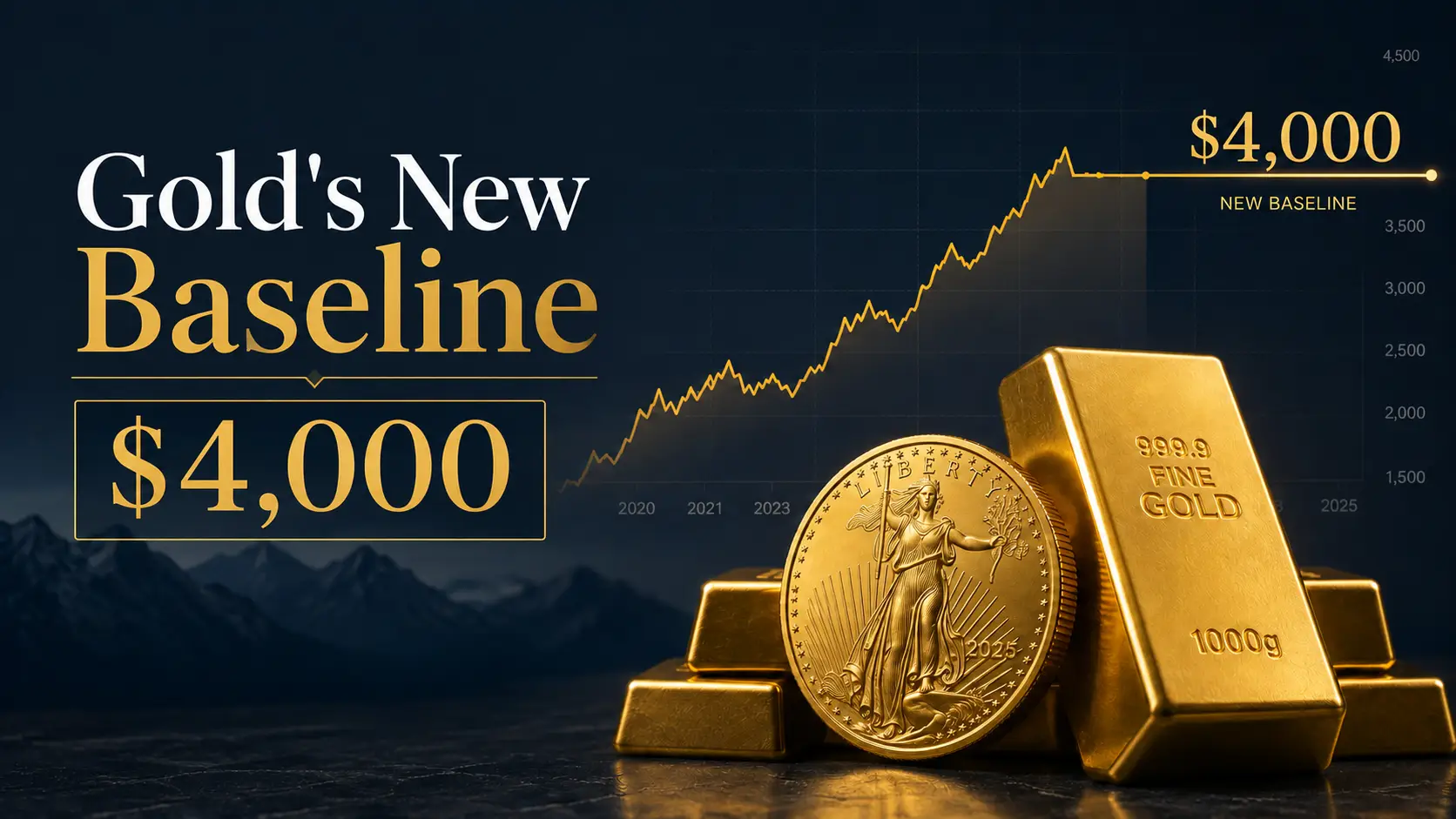
For years, investors watched gold reach price levels that once seemed almost unimaginable. First $2,000 an ounce, then $3,000, then $4,000. Earlier this year, gold climbed above $5,500 before experiencing a substantial correction. Yet even after that decline, the market has continued to revolve around the $4,000 range.
That raises an important question: What if $4,000 isn’t simply a high price for gold? What if it’s becoming gold’s new baseline?
No one knows exactly where gold will trade tomorrow, next month or next year. Gold can move sharply in either direction. But look at where some of the world’s largest financial institutions are setting their expectations. Bank of America recently lowered its 2026 gold forecast and still projects an average price of approximately $4,360 an ounce. ING forecasts approximately $4,300 in the third quarter and $4,600 in the fourth quarter. Goldman Sachs has projected $4,900 by December 2026, while J.P. Morgan’s outlook goes considerably higher.
The significance isn’t simply that these institutions expect higher gold prices. It’s that $4,000 gold is no longer being treated as an extraordinary prediction. It has become part of the price range around which major financial institutions are building their expectations.
For many people, that’s difficult to accept. They remember gold at $1,500, $2,000 or $2,500 an ounce, so today’s price naturally feels expensive. But markets aren’t valued according to what something used to cost. They’re valued according to the conditions that exist today and expectations about what comes next.
And today’s conditions are very different. Central banks remain important participants in the gold market. Government debt and deficits continue to grow. Geopolitical uncertainty remains elevated. Questions surrounding inflation, interest rates and the long-term purchasing power of currencies haven’t disappeared.
Perhaps the greatest risk for someone considering physical gold today isn’t simply that gold could decline. There is also the risk of waiting for a price that belonged to a different economic environment.
Investors who thought gold looked expensive at $2,000 eventually watched it cross $3,000. Those who hesitated at $3,000 watched it cross $4,000. That doesn’t mean gold must continue higher, but it does demonstrate how quickly the market can establish a new reference point.
If $4,000 is becoming that new reference point, waiting indefinitely for yesterday’s gold market may deserve some reconsideration.
There may never be a perfect moment to make a decision about physical gold. There will always be another Federal Reserve meeting, another economic report, another geopolitical development, or another reason to wait. But there are times when changing conditions suggest that simply watching from the sidelines carries risks of its own.
This may be one of those times.
Before deciding that gold has become too expensive, consider a different question: If $4,000 is becoming gold’s new baseline, how long do you want to wait to determine whether physical gold belongs in your strategy? Call Nationwide Coin & Bullion Reserve today for a no-obligation conversation about physical gold, your objectives, and the options available to you. There is no reason to make a rushed decision—but with the world’s largest financial institutions adjusting to a dramatically higher gold market, there may be a very good reason to make that decision now.