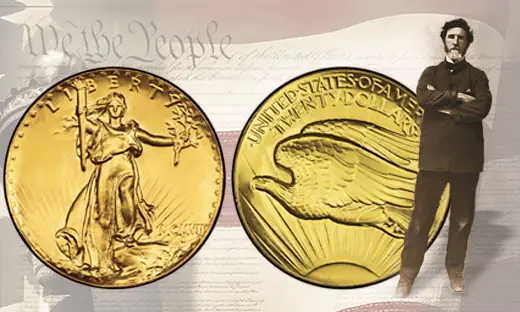
Celebrated as the most beautiful gold coin ever produced, the 1907 Double Eagle Gold Coin designed by sculptor Augustus Saint-Gaudens has four versions. President Theodore Roosevelt requested that Saint-Gaudens design the coin in an ancient Greek high-relief style. What Saint-Gaudens produced was a numismatic masterpiece. But it was entirely impractical. The ultra-high relief design on the 34-millimeter coin required at least nine strikes from the U.S. Mint’s hydraulic coining press. Moreover, because the design elements were dramatically elevated, the coins could not be stacked on top of each other, making them impractical for banking and commercial purposes. About 20 of these invaluable masterpieces were produced. Most are in private collections today.
A second ultra-high-relief version was minted on an extra-thick 27-millimeter blank that U.S. Mint employees created by melding together two $10 Gold Eagle planchets. But the Mint leadership recognized they had no authority to issue coins with such specifications, so almost all of the trial coins were melted. Only two of these coins are known to exist and they are held at the Smithsonian Institution.
The third version, at 34-millimeters in diameter, was coined in high relief, rather than ultra-high-relief. About 12,000 of these coins were minted and issued. Today, a mint version of this $20 face value coin can sell for as much as $750,000.
The fourth and final version of the Double Eagle minted in 1907 lowered the relief and replaced the Roman numerals with Arabic numbers. More than 360,000 of these coins were produced. Uncirculated mint state examples of this coin can now sell for $175,000.